
Welcome to the Gergely Lab!
Our group wants to shed light on the basic principles of cell division and understand how abnormal cell divisions contribute to pathologies.
In 2020 we moved to the Department of Biochemistry, University of Oxford. You can read more about what we do here.
For life to continue, cells need to be continuously replenished through cell divisions. Each division requires the precise duplication and distribution of the cell’s genetic material, packaged into chromosomes. This process is orchestrated by the mitotic spindle, a dynamic structure made of microtubules, protein filaments that grow and shrink to capture and align the chromosomes. At either end of the spindle are centrosomes: compact yet vital organelles that organise the microtubules and ensure correct spindle formation.
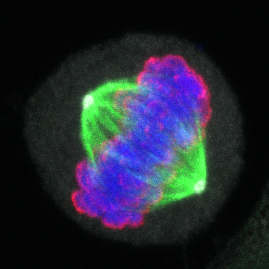
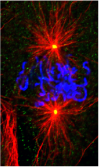

Our research is focused on understanding the centrosome. Centrosomes contain around 200 different proteins. A small, highly conserved set of these proteins ensures that the organelle duplicates precisely once per cell cycle. Other components support a variety of essential functions, including the assembly of the mitotic spindle and the formation of cilia, antenna-like projections that extend from the cell surface. Cilia act as important signaling hubs, detecting and responding to cues from the environment.
Failures in centrosome function can have serious consequences. In addition to contributing to genomic instability through abnormal spindle formation and chromosome segregation errors, mutations in centrosomal genes are also linked to a variety of developmental diseases. These include conditions such as primary microcephaly, where brain size is severely reduced, and primordial dwarfism, characterized by overall stunted growth.
Moreover, defective centrosomes can impair ciliogenesis, leading to a group of disorders known as ciliopathies, which affect multiple organs and systems including the brain, kidneys, and eyes.
In healthy cells, centrosome number and function are tightly controlled. Disruption of this balance can lead to a cascade of cellular errors. Understanding how centrosomes and their associated proteins operate is key to uncovering the root causes of these complex diseases—and a central focus of our research.
We are part of an exciting collaboration working on intrinsically disordered protein domains and their regulatory roles in the cell cycle.
We are funded by the BBSRC and MRC along with the University of Oxford and the EPA Cephalosporin Fund.
 The Gergely Lab